I thought it would be easy to define a subplot. And I was under the impression that all long-form stories pretty much require subplots. But it turns out that “subplot” might be a limited term, and a story with subplots circulating a main event-oriented plot is just one type of story.
I’ve recently been planning for a class on subplots, so I’m seeing these things everywhere—the novel I’m currently reading has several; most of the classics I taught to high schoolers have them; recent TV shows and movies I’ve watched definitely have them.
But in my first attempts to actually delineate what a subplot is, I kept coming up against some specific conundrums.
Brevity ≠ Subplot?
The first complication is what I might term the brevity problem. Jason Pargin’s novel I’m Starting to Worry About This Black Box of Doom has its two main characters, Abbot and Ether, on a road trip across the country to deliver a mystery black box. At one point, they stop at a Circle K for gas, and Pargin gives us a chapter from a new POV that begins like this:
Twenty-two-year-old Tanisha Clark was not a true-crime enthusiast and definitely hadn’t been following the internet investigation into the mysterious white SUV and its ominous cargo. She had, however, noticed “Circle K” trending on Twitter earlier and had clicked on it because she worked at a Circle K and was, of course, curious to know what terrible news had caused the company to trend.
Tanisha goes on to experience a quasi nervous fit that echoes the sort of living-in-the-world anxiety that Abbot, the main character, experiences regularly. But ultimately, she doesn’t leave the scene when things get worse. In fact, without giving you spoilers, I might even argue that she saves the day at this local level.
In all, Tanisha’s mini story spans 20-some pages, though her POV only takes up about four of those 20 pages. Would you call this a subplot? It has an arc for the character at its center. It feeds into the main plot’s action (her post on social media brings several antagonists on the scene). And it even echoes some of the protagonist’s character flaws.
But some would argue it’s too brief to qualify as a subplot. It’s just a little side story or episode. I’ve typically seen subplots defined as “a secondary storyline that runs alongside the main plot.” Tanisha’s story does not do that.
Narrative Weight and Main Plots
The second complication is what I’d call the narrative weight problem. A subplot is subordinate, secondary, supportive. But what if the supposed subplot ends up vying with the main plot for primary status?
Take The Remains of the Day, for instance. Like Pargin’s Black Box of Doom, this is a road trip novel. Unlike Black Box, however, Remains of the Day’s road trip is not the main plot.
Perhaps we need to define “main plot.”
I’d argue that the main plot of a story is the series of events that adheres to the story’s most pressing narrative question.
For some stories, there’s a pretty clear delineation between that main-plot series of events and other chains of events.
In Pride and Prejudice, the most pressing question is Will Elizabeth and Darcy overcome misjudgment and pride to arrive at a mutual understanding and marriage? There are clear subplots that remain more or less continuous throughout the novel and that have clear interaction with the main plot.
- The Jane/Bingley plot parallels and delays the central line.
- The Charlotte/Collins plot provides a contrasting model of marriage.
- The Lydia/Wickham plot changes Darcy’s position and Elizabeth’s perception.
All three plots also help us understand the meaning of marriage in a world in which marriage is essentially a transactional/financial institution. Sure, it can be for love between two good people (Jane/Bingley), but more often, it’s a question of financial security between people who tolerate each other (Charlotte/Collins), or it might be exploitative (Lydia/Wickham).
But in The Remains of the Day, what’s the main plot? As I said, I don’t believe the road trip is the main plot. Is just a present-time frame. There is no pressing question around whether Stevens will reach his destination. I suppose there’s a pressing question around how Miss Kenton might respond to Stevens, but mostly what we’re watching as the story proceeds is Stevens coming to make sense of himself as he reflects on the past, thinking about his father, about his professional relationship with Miss Kenton, about his service to Lord Darlington, and about the international diplomacy that occurred at Darlington Hall. For me, the most pressing question in the novel is Will Stevens arrive at an honest understanding of what his devotion to dignity and service has cost him emotionally, morally, and personally?
And there isn’t one plot that creates that question. It kind of bounces around all of those plots I mentioned above.
Figure out the Center
Now, we might point out that Pride and Prejudice is really more of an event-centered novel, whereas The Remains of the Day is more of consciousness- or character-centered novel.
It makes sense, then, that in an event-centered novel, other series of events will subordinate to the event at the center.
In a character-centered novel, since the most pressing narrative question is not about an event but a person, various plots may end up working side by side to illuminate the character.
Are there other centers?
I might propose two more.
One would be a system-centered novel. Perhaps “system” isn’t the best term, but the idea is that we’re looking at a group of people—a society either in the smallest of units (a family or group of friends) or in a larger unit (a social system).
The Song of Ice and Fire series (called Game of Thrones when adapted to TV) circulates around the question of who will sit on the iron throne next and what role leadership plays within a society. It’s a question that requires an ensemble to articulate.
I would argue that the main plot/pressing questions in books like Ann Patchett’s Commonwealth, Jonathan Franzen’s The Corrections, Yaa Gyasi’s Homegoing, and Min Jin Lee’s Pachinko —just to name a few—are actually about an entire society or social group—how a family comes to reconceptualize their ties or how inherited forces travel through generations and shape the people they touch.
So again, in such novels, it makes sense that various threads are working together rather than subordinating under a central chain of events.
And the other type I would propose is the theme-centered novel. I’ll be the first to tell you that every novel has a theme (see my article about how theme is not optional). So I want to be clear that I’m not creating some deranged distinction between books with theme and books without. But some books are actually held together by theme—that is, theme is a structural element. Cloud Atlas has no coherence without theme. Jennifer Egan’s A Visit from the Goon Squad and Candy House have theme as the unifying core. I might slot Olive Kitteridge into this category, too.
If the center of the novel is anything other than events—that is, the most pressing narrative question is not about what happens—then various plots might be working side by side rather than in some hierarchy. In other words, we’re not dealing with subplots, we’re dealing with multiple threads.
A recap:
- Event-centered: What happens?
- Character-centered: What happens within a person?
- System-centered: How do interacting forces operate?
- Theme-centered: What recurring idea creates unity across otherwise dispersed parts?
Again, though, I want to emphasize that just because a novel is centered in one way does not mean it’s lacking in other ways. An event-centered novel can have a big dose of character development or theme. A theme-centered novel definitely doesn’t create flimsy characters. Claire Keegan’s Small Things Like These is a character-centered piece, I would argue, but there’s certainly a series of events that put pressure on the main character and force a decision from him.
Architectures
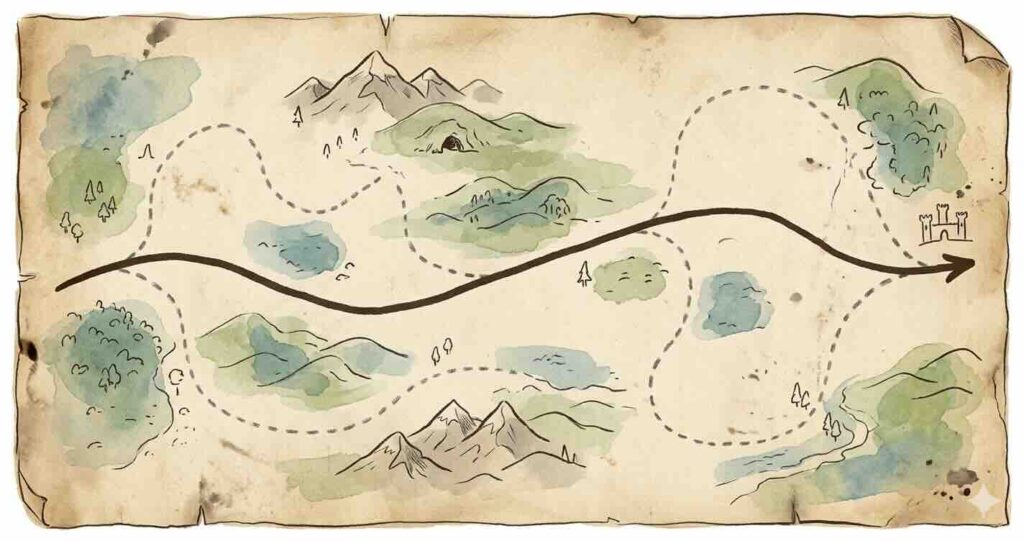
For the sake of wrapping our heads around subplot, I wonder if it would help to consider that there are a few different architectures that position plots in relation to one other. Some of those other plots are subplots; some are not.
A hierarchical architecture has a clear main plot series of events at the core, with other event threads serving that core. Pride and Prejudice is a clear example. Donna Tartt’s The Goldfinch puts Theo’s trajectory from the bombing forward at the center; the Amsterdam thread, the antiques underworld thread, and the Boris relationship all subordinate to it. Cormac McCarthy’s The Road puts the father-son survival journey at the center. The other stuff—the flashback threads, the encounters with strangers—serves that central line.
A multiple-strand architecture has co-equal strands that interweave to create the main plot. That may be just two strands that provide point and counterpoint, or it may be a handful of strands that interweave. These strands may differ in tone, time frame, point of view, or prominence, but none is subordinate exactly. The Brief Wondrous Life of Oscar Wao might seem to put Oscar at the center, but really, the story is about the fukú, which doesn’t belong to Oscar; it belongs to the family, to the Dominican Republic, to the entire history of Trujillo’s regime. In Emily St. John Mandel’s Station Eleven, the pre-collapse Arthur Leander strand and the post-collapse Kirsten strand are co-equal. Neither subordinates; their convergence is the point.
And though this may be a subset of multiple-strand architecture, I want to mention the idea of a constellation architecture, which would include interlinked stories or novels in stories. The center of such stories is usually either thematic or system. In addition to those I’ve mentioned already, think The Overstory by Richard Powers or The Throwback Special by Chris Bachelder.
So What?
Why expend this much energy defining subplots? Because I want to give you permission to write the story you want to write, and the best advice is not necessarily that every subplot must serve the main plot.
Every narrative strand must place some kind of pressure on the story’s center.
But the writer needs to figure out how they want to use those strands. At some point in your process, I think it’s worthwhile to try to figure out what kind of story you’re writing and what kind of narrative thread architecture works for that purpose. If the center is not event-driven, then there may be a different relationship among the plots.
What kinds of pressure can strands place on the narrative’s center? Consequence is one option (something in the subplot or co-equal plot reverberates across other plots). But reframing is another common pressure (what we learn in one plot forces a reinterpretation of another).
I also talk often of how a subplot or co-equal plot can amplify (get us feeling more drawn to the character or their objectives or the nature of the threat to them).
And sometimes, the plots function to create a sort of accumulation (meaning emerges only after enough pieces are in place; the whole exceeds the sum of its parts).
I’ll be going into more depth with subplot / multiple threads in this month’s Writing Craft Club class conversation. We’ll meet Thursday, March 23rd at 2pm central time. It will be recorded. Join us by signing up for the Writing Craft Club.